

How We Caught and Released a Great White Shark from Shore on Pensacola Beach
Every shark guide has a fish that changes the way they talk about the ocean. Ours showed up on a cold January night in 2026. A great white shark, caught and released from shore on Pensacola Beach, is not something Blaine or I ever expected to write a sentence about. You do not target white sharks. You cannot keep one. They are protected, and for good reason. But the Gulf does not read the rulebook, and one night a fish came into the wash that none of us will forget. This is the full story, and it is also the story of how a protected giant went back into the water where it belongs.
Great White Sharks Are Protected, and That Came First
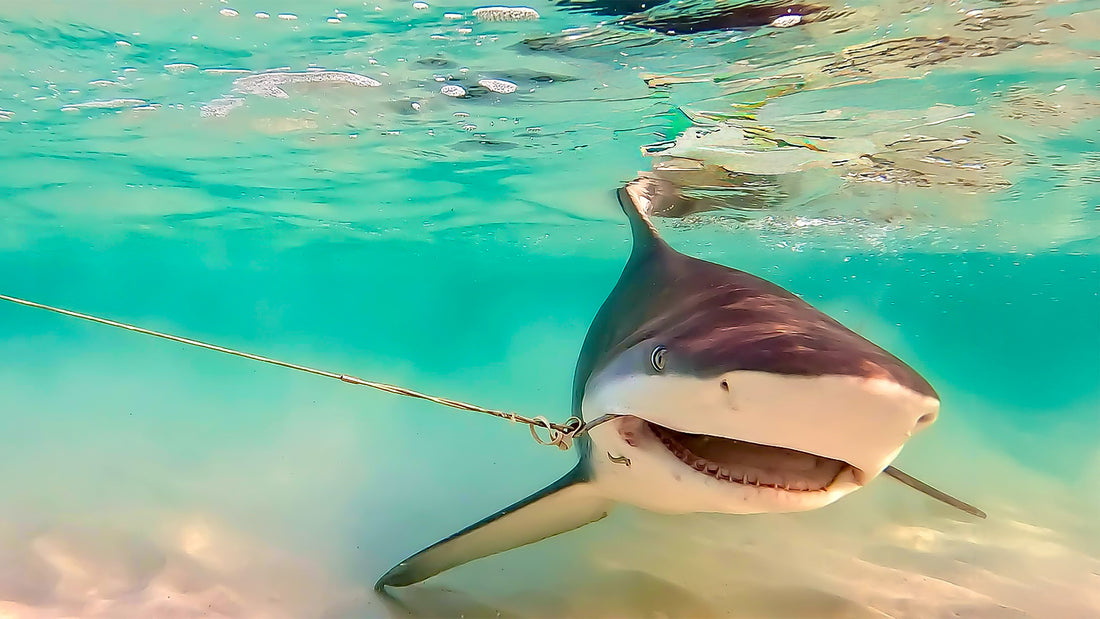
Before any of the fun part, the rule. The great white is a prohibited species in Florida and in federal water. You cannot target it, keep it, harvest it, or drag it up onto dry sand. The Florida Fish and Wildlife Conservation Commission is plain about it: a prohibited shark has to stay in the water with its gills covered and go back without delay. That rule does not bend for a fish of a lifetime, and we would not want it to.
So let me be clear about what this catch was and what it was not. We were not out hunting a white shark. No one fishes for them on purpose, and anyone who tells you they do is selling something. We were running a long winter trip for big bull sharks off the beach, soaking heavy baits in cold water, and a fish hit that was bigger than anything we had a name for until we saw it. From the first run, the plan was the same plan we use for every protected shark that grabs a line. Keep it in the water, get it handled fast, send it home strong.
If you want the plain-language version of which sharks come home and which ones go straight back, our shark fishing safety and catch-and-release guide walks through the Florida rules without the jargon.
A Cold Night, a Long Soak, and a Bull Shark Trip That Went Sideways
January on Pensacola Beach is a different animal. The crowds are gone, the water sits in the upper fifties, and most people assume the shark fishing shuts off with the cold. It does not. Winter is when the biggest bull sharks of the year cruise the beach, fat and slow and hungry, and we run a handful of long overnight sits chasing them when nobody else is out there.
This was one of those trips. Two of us, a spread of heavy rods staked in the sand, and a kayak run to drop baits well past the second bar where the water dropped off into the dark. We had been on the beach since the afternoon, and the bite had been the kind of slow that tests your patience. A couple of smaller fish early, then hours of nothing but surf and a cold wind off the water. We were close to calling it a quiet night.
Then one of the big reels did something a bull shark does not do. Instead of a hard, fast run, the line came off the spool in a long, heavy, unstoppable pull, like the bait had been tied to a truck. Blaine got into the harness and leaned back, and the rod bowed over and held there. No headshakes, no panic. The fish had taken the bait and kept walking, and there was nothing either of us could do for the first few minutes but hold on and watch line disappear.
The Fight That Told Us This Was Different
You learn to read a fish through the rod. A bull fights in bursts. A big ray digs in and sits. This was neither. This thing moved at its own pace and went exactly where it wanted, and for a while that was straight down the beach, parallel to the surf, peeling line off a reel that has stopped fish north of three hundred pounds without breaking a sweat. We followed it on foot, working down the sand in the dark, trading the rod when arms gave out.
It took the better part of an hour to turn it. The leader finally came up, we got a light on the water, and the size of the thing rearranged how we were thinking about the whole night. A broad back, a tail taller than a person, and a girth that did not match any bull we had ever brought into the wash. We still did not say the words out loud. You do not, until you are sure.
We worked it into knee-deep water at the edge of the wash, the way we handle every big shark that comes to the beach. The fight was over, but the most important part of the night was only starting, and we knew it. A fish like that, you get one shot to do right by it.
Releasing a Fish You Cannot Keep
Up close, in the beam of a headlamp, there was no more guessing. The conical snout, the black eye, the slate-gray top fading to white, the sheer mass of it. A great white shark, in the wash, on Pensacola Beach, in January. We have caught a lot of sharks. None of us had ever stood next to one of these.
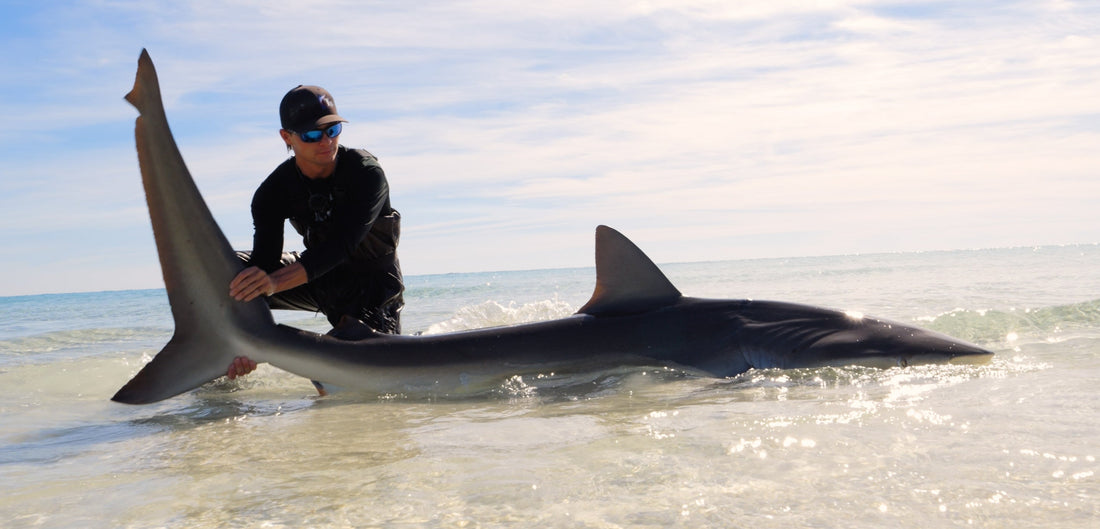
Here is the part that matters most. We did not pull it up onto dry sand, and we never would. We kept it in the water at the edge of the surf, gills covered, while we worked fast. We did not put a tape on it. No measuring tape comes out on a fish we are releasing, and one that size was never going to be the exception. Dylan called it at right around thirteen feet six inches by eye, and researchers later estimated the weight at about eighteen hundred pounds. We have those numbers because we worked fast, in the water, not because we kept the fish out to pose with it. The hook was set in the corner of the jaw, easy to reach, and the leader came free clean.
Then we pointed it at the Gulf and let it go. It sat for a second in the shallows, found its balance, and pushed off with one slow sweep of that tail. We watched the wake until it was gone. No high-fives, no yelling. Two guys standing in cold water at two in the morning, quiet, watching the biggest fish of their lives swim back into the dark where it came from. That release is the whole reason this is a story we are proud to tell.
The Gear That Held a Fish It Was Never Built For
People always ask what we were using, so here it is, with the honest caveat attached. None of this gear is meant for great whites. We run it for the big bull sharks that make winter on the beach worth the cold, and on that night it happened to be enough to bring a much larger animal to the wash and turn it loose safely.
The reels are the Okuma Makaira LBS we helped Okuma design for exactly this kind of land-based fight, loaded with 200 lb braid under a short 250 lb mono top shot. The business end was one of our Terra Firma Tackle Leaders, built to handle teeth and sandpaper skin without parting under heavy drag. A circle hook in the corner of the jaw, which is what made the release clean and quick. There was no magic in any of it. The setup we trust for big bulls held together long enough to do the job, and the corner-hooked circle hook did what it is supposed to do, which is let a fish go without harm.
If you are curious how we put a spread together for the big winter sharks we set out to catch, our guide to catching bull sharks from the beach breaks down the tackle and the approach.
A Great White on Pensacola Beach in Winter
The first question everybody asks is whether a great white on the Gulf Coast is even real. It is, and the science backs it up. White sharks are cold-water animals, and the satellite tagging programs that follow them have shown for years that they move into the Gulf in the dead of winter, riding the cooler water down and along the coast before heading back out as things warm up. December through February is the window. They are not common, and most pass through far offshore without anyone knowing, but they are out there.
That lines up with everything about our night. Cold January water, a big bait soaking off the beach, the exact season the tagging data says these fish slide through. We did not do anything special to make it happen. We were in the right stretch of sand on the right cold night, doing what we always do, and the Gulf handed us a once-in-a-lifetime fish. That is the honest version. The beach gives you what it gives you, and once in a great while it gives you something that leaves you speechless.
For more on how the seasons change what swims past the beach, our night shark fishing breakdown covers why the after-dark and cold-weather sits punch above their weight.
This Catch Is About Conservation, Not a Trophy
We could have made this whole post about how big the fish was. We would rather make it about why it swam away. Great whites are protected because they grow slow, mature late, and have very few pups, which means a population takes a long time to recover from being hammered. Killing one does real damage. Releasing one in good shape costs you nothing and keeps the ocean the way it should be. Our great white shark fishing in Pensacola page covers what we know about these fish on this stretch of coast.
That is why we practice safe catch and release shark fishing for conservation on every trip, not only when a camera is rolling and not only for the protected species. The same care that sent that white shark home is what we give a forty-pound sharpnose a kid reels in on a summer afternoon. Keep the fish in the water, handle it fast, cut the leader if the hook is deep, and let it go strong. The thrill is in the fight and the photo at the water's edge, not in the kill. If more people fished that way, the beach would be better for all of us.
If you want the full rundown of Florida's shark rules, including which species are off limits and the free shore-based permit, our guide to Florida shark fishing regulations lays it out.
Want the full breakdown of how we rig for winter sharks from the beach? It is all in the free Shark Fishing Academy at catchmoresharks.com.
Come Fish the Beach With Coastal Worldwide
We cannot promise you a great white. Nobody can, and anybody who does is lying. We can promise a real shot at a big shark from dry sand, run by two guys who have spent their lives reading this stretch of beach. We run trips at three lengths, a six-hour at $1,200, an eight-hour at $1,500, and the twelve-hour at $2,100 that gets you deep into the best hours. Every booking holds with a $200 deposit. We bring the heavy gear, the bait, and the spot, and we handle every fish the right way.
The sharks we set out for, the bulls and blacktips and spinners and sharpnose, will bend a rod hard enough to make your arms ache and your week. And every so often, the beach has a surprise in it that none of us see coming. Take a look at our beach shark fishing trips in Pensacola and then reach out to us to lock in a date. Bring a friend, bring some patience, and let us put you on a fish you will be talking about for years.
