
Bull Sharks from the Beach: How We Catch Bulls from Shore in the Gulf
Ask anyone who's spent real time on Pensacola Beach with a heavy rod in the sand, and they'll tell you the same thing: bull sharks are the fish that keep you coming back. Pound for pound, they pull harder than almost anything that swims in the Gulf. They don't sulk, they don't give up, and when one loads your rod for the first time, you understand why we built Coastal Worldwide around beach shark fishing in the first place.
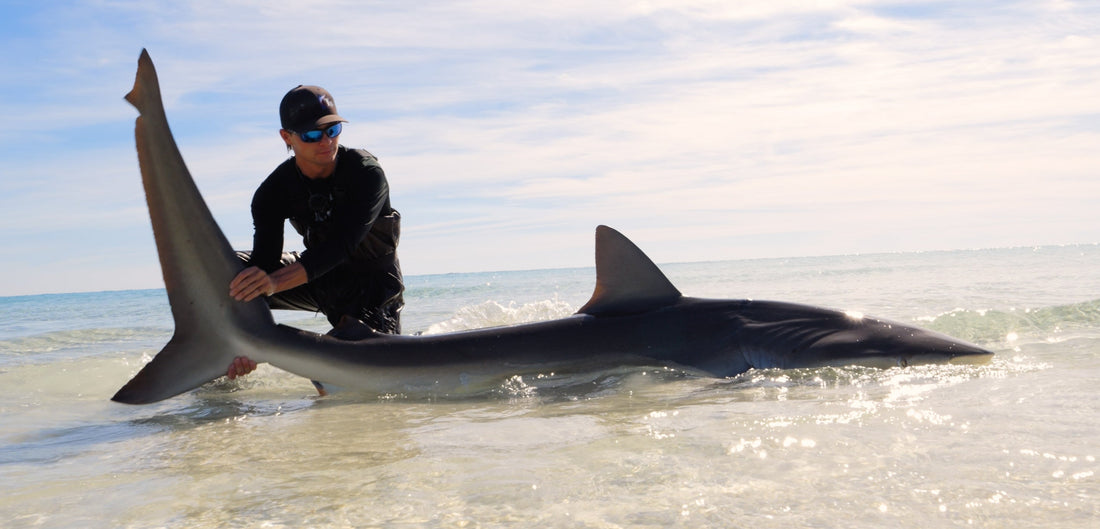
Bull shark fishing from the beach is the foundation of what we do. Dylan and Blaine have been chasing these fish along the Emerald Coast for years, and we've put more clients on their first bull shark from shore than we can count. If you've ever wondered how it works, how we find them, what we use, what the fight feels like, this is the guide.
Why Bulls Are the Perfect Shore-Based Target
A lot of people assume you have to go way offshore to catch a real shark. We've spent a lot of trips proving that wrong, the sand will put you on fish most people never see. Bull sharks are built for the kind of water we fish. They love warm, shallow, sandy habitat. They push into the same sloughs and troughs where mullet and jacks school up, and they'll cruise within casting distance of the sand more often than most people realize.
A few things make them the ideal target from shore:
- They're aggressive eaters and commit hard to a bait.
- They live in the first and second sandbar zone for big stretches of the year.
- They come in every size class, from 4-footers up to legit 400-plus-pound fish.
- They fight mean. A solid bull on 80-wide tackle is a test of your back, your legs, and your patience.
When we talk about beach shark fishing in Pensacola, bulls are usually the fish we're quietly hoping for. Tigers and hammerheads get the headlines in summer, but bulls are the workhorse. They're around in real numbers from late spring through fall, and when the water warms up, they become the most reliable "big fish" bite on our stretch.
When Bull Sharks Move Close to Shore
Bulls are temperature animals. Once our water pushes into the mid-70s, usually around April, they start showing up in our catch logs. By June they're thick. July and August are prime, and the bite can stay strong all the way through October when the bait is still around.
Tides matter more than most first-timers expect. Around Pensacola Beach, we like the tail end of an incoming tide into the first few hours of the outgoing. That's when bait is pushed into the trough, predators line up on the dropoff, and our spreads land right in the middle of the highway. We'll also fish the top of a hot tide on flat, calm evenings because bulls will come in close to hunt once the sun drops.
If you want the deeper seasonal breakdown of when each species shows up, we wrote a full guide on the best time of year for shark fishing in Pensacola. That one pairs well with this post.
Reading the Beach Before You Cast
Every client trip starts with us walking the beach. Before we touch a rod, we're looking at three things.
The trough
That's the deeper cut of water between the sand and the first bar. Bulls patrol it like a hallway. If we can see a clear, defined trough, we're already halfway to a bite.
The cuts
Breaks in the sandbar where water is moving. These are funnel points for bait, and bulls set up on them like bass sit on a creek mouth.
The birds and the bait
Nothing tells you more than activity. Diving terns, nervous mullet, jacks blowing up, that's a feeding zone, and we want our baits in it.
We're not guessing. Every spot we fish is picked on purpose. Coastal Worldwide has been running trips on this stretch long enough to know which sections of Pensacola Beach hold bulls on which winds and which tides.
The Tackle We Use for Bulls from Shore
This is where a lot of DIY guys get into trouble. Bull sharks don't care about your setup, they'll pull it apart if it's not built for them. Our beach spread is heavy on purpose.
We run Okuma Makaira LBS reels for the big sharks, loaded with heavy braid and a long top shot of quality mono. These reels are the ones we helped Okuma design specifically for this kind of fishing, shore-based, big fish, hard fights kept short with heavy drag in sand and salt. That's the tool that gives clients a real shot when a 300-pound bull loads up.
For leaders, we use Terra Firma Tackle Leaders, which we designed for shore-based shark fishing. They hold up to bull shark dentition and the kind of abrasion you get from sand, sharp tails, and heavy-drag fights. We sell them on the Coastal Worldwide website if you want to run the exact same setup.
Hooks are circle, heavy wire, non-offset. They work for the shark and they work for release, which matters because we practice catch and release on every bull we land.
Rods are custom builds with backbone from the reel seat to the tip. Soft rods lose fish.
Bait Choice and Bait Deployment
Bulls are opportunists. They'll take a fresh cut bait and they'll take a live bait, and the right call depends on the day, the tide, and what's moving on the beach. Fresh bonito, jack, mullet, and stingray wings are all in our rotation. We catch a lot of our own bait on site, and there's a reason for that, fresh matters.
We deploy baits with a kayak, not by casting. A kayak lets us place a bait 400 to 600 yards out, right on the dropoff of the second bar, where a bull is more likely to be patrolling than it is in the first cut. Nothing flashy about it, just effective. Precise placement is a big part of why our hookup rate is what it is.
One thing we do not do is try to "attract" sharks in any way that would put other beachgoers at risk. Our spread is about getting a bait to where a bull is already hunting, not bringing the fish any closer to the sand than it would naturally come. Safety for everyone on the beach is part of the job.
What the Fight Looks Like
Here's where beach shark fishing separates itself from anything else you've ever done. When the clicker goes off on a big bull, your life is about to change for the next half hour.
You're on dry sand the whole time. Feet planted, harness on, fighting belt tight. We coach you through the angles, when to pump, when to stop, when to walk the fish down the beach. You're never in the surf. The shark is brought to the swash, worked fast in the wash for a photo, then sent back healthy.
We've had clients who came in thinking they were tough and found out halfway through a bull shark fight that their arms aren't what they thought they were. It's the honest truth. Bulls are strong, and they don't quit. That's exactly what makes landing one so memorable.
A Few Real Catches from Our Logs
Over the years we've put clients on bulls up to 10 feet. A 9-foot-plus bull on Pensacola Beach is a body-and-a-half of fish, and the pictures don't do it justice until you're standing next to one. We've had double hookups on the same rigging session, we've had families land their first shark together, and we've had guys come back year after year because one bull hooked them for life.
We're not going to pretend every trip ends with a monster, nobody can promise that in shark fishing. What we can promise is that every trip is run by people who know this beach, on gear built for these fish, with baits deployed on purpose. That's how you stack the odds in favor of a real bite.
If you want the bigger picture of what a day on the sand with us looks like, our team broke it down in what to expect on a beach shark fishing trip.
Regulations, Permits, and Conservation
Florida FWC requires a free shore-based shark fishing permit for anyone targeting sharks from land. Anglers 16 and older also need a Florida saltwater fishing license. Bulls are a managed species under state and federal rules, and we run strict catch-and-release on our trips. Every fish goes back.
If you would rather learn to catch bulls yourself than book a trip, that is fine by us. The free Shark Fishing Academy at catchmoresharks.com covers the rigs, baits, and beach reading we use on every bull shark trip.
Ready to Catch Your First Bull?
If this is the kind of fishing you've been thinking about for years, this is the year to do it. Our trips are guided from start to finish, all the heavy gear is included, and we run them in a way that's family-friendly while still putting you on real fish.
Pricing for guided beach shark fishing trips with Coastal Worldwide is 6 hours at $1,200, 8 hours at $1,500, and 12 hours at $2,100, with a $200 deposit to hold your date. Full details are on our beach shark fishing page.
When you're ready to book, head over to our contact page and reach out. Tell us what dates you're looking at, how many people are coming, and we'll get you on the calendar. The bulls are out there right now. Let's go put you on one.
Where We Fish on the Gulf Coast
Coastal Worldwide runs guided beach shark fishing trips across about 100 miles of coast, from Alabama down through the Florida panhandle. Wherever you book, you get the same gear, same guides, same beach-only experience.
Florida: shark fishing Perdido Key · shark fishing Pensacola Beach · shark fishing Navarre Beach · shark fishing Destin
Alabama: shark fishing Orange Beach · shark fishing Fort Morgan · shark fishing Gulf Shores
