
Shark Fishing Tackle Setup: The Land-Based Rig
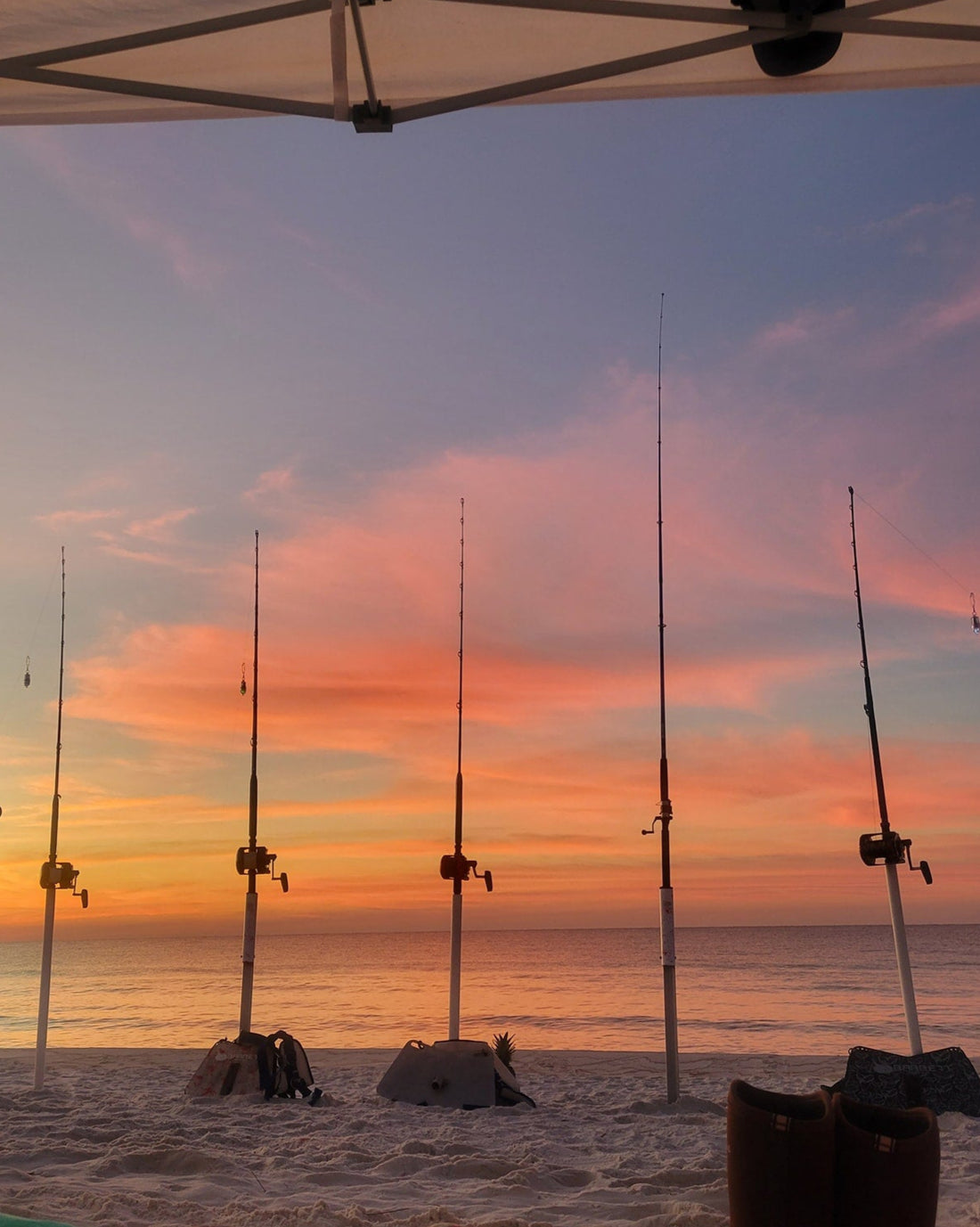
Shark fishing tackle gets bought backwards by almost everybody. People spend their whole budget on the biggest reel they can afford, spool it with whatever the shop hands them, then lose the fish of their life because a nine dollar swivel opened up in the second wave. We run land-based trips on Pensacola Beach year round, and the gear that ends up in our trucks is not the flashiest gear on the rack. It is the gear that survives sand, salt, Gulf current, and a seven foot bull pulling straight down the beach at two in the morning.
This is the shark fishing tackle setup we use from dry sand. No boat, no dock, no shortcuts. Rod, reel, line, leader, hook, weight, and the beach hardware that holds it all together.
On this page
- Rods for land-based shark fishing
- Reels and drag
- Mainline, topshot, and how much you need
- Leaders, the part most people get wrong
- Hooks and the Florida circle hook rule
- Weights that hold in Gulf current
- Sand spikes and the rest of the beach kit
- Shark fishing tackle compared: cast out vs kayak deployed
- Gear choices that change your permit requirements
- FAQ
Rods for land-based shark fishing
A beach shark rod does two jobs. It gets a heavy bait past the bar, and it holds pressure on a fish that is running parallel to shore instead of straight down. Those are different problems from offshore fishing, and they are why a stand-up boat rod usually disappoints people on sand.
For cast-out work we run 9 to 12 foot rods rated for 6 to 12 ounces. Length buys you two things: distance on the cast, and rod tip height so your line clears the breaking waves instead of getting dragged sideways by every set that rolls through. A short rod puts your line in the wash, and line in the wash means a sawed-off leader and a lost fish.
For kayak or drone deployed baits, the rod gets shorter and stiffer. You are not casting, so you do not need the lever. You need backbone. A 6'6" to 8' rod rated for 50 to 130 or 80 to 130 pound line class handles a big bait sitting 300 yards out and gives you something you can hold onto when you are pulling heavy drag on a big fish.
Two details separate a beach rod from a boat rod. Roller guides or heavy oversized guides, because braid under load will cut a cheap ceramic insert in one season. And a gimbal butt, because you will be fighting standing up with a belt on, not sitting in a chair.
Rod holders matter more than rod brand
A well built rod in a bad holder is a rod on the ground. More on that below in the beach kit section, but budget for it now instead of finding out later.
Reels and drag
Reel choice comes down to line capacity and usable drag, in that order. A big shark from the beach does not fight the way people expect. There is no motor to chase with. The fish takes what it wants, and your only answer is a spool deep enough to let it go and a drag smooth enough to keep pressure on for the twenty or thirty minutes it takes to turn one around.
We run Okuma Makaira LBS reels. Dylan worked with Okuma on the design specifically for this kind of fishing, so the drag range and the spool geometry are built around beach deployment rather than trolling. Whatever brand you land on, the numbers that matter are these:
- Capacity: about 300 yards of 65 to 80 pound braid for cast-out work. For deployed baits, 800 yards and up.
- Usable drag: 15 to 20 pounds on cast-outs. On the deployment reels we set 35 pounds at strike and about 75 pounds at full, measured at home on a crane scale. Manufacturers publish max drag numbers you will never fish.
- Sealing: a beach reel gets buried in sand at some point on every trip. Sealed drag stacks and stainless bearings are not a luxury here.
- Lever drag over star drag for the big setups. Being able to bump from strike to full in one motion without guessing is worth the price difference.
Rinse the reel with fresh water the same night, not the next morning. Salt sitting overnight on a beach reel costs more than the rinse is worth.
Mainline, topshot, and how much you need
Braid for the mainline. Hollow core if you plan on splicing, solid core if you are tying your own braid to mono connection. On cast-out reels, 65 to 80 pound braid is right, and about 300 yards of it is plenty. On deployed baits we run 200 lb braid, at least 800 yards, because heavy braid is what lets you run heavy drag and keep the fight short.
On top of the braid on a deployment reel, a short topshot of 150 to 250 pound monofilament. Ours is 250 pound. The mono gives you three things braid cannot: stretch that keeps a hook from pulling on a headshake, abrasion resistance where the line rubs sand and the shark's body, and something you can grab with a gloved hand at the end of the fight.
The connection between braid and topshot has to pass through your guides cleanly. A bulky knot that hangs on the tip top will cost you a cast, and eventually a fish. A hollow core splice is the cleanest connection there is and a PR knot is right behind it, but we tie an FG knot on every rod we own because it needs no tools, goes fast, and has never failed us. This is the one place where practicing at home pays for itself.
Leaders, the part most people get wrong
Everything upstream of the leader is replaceable. The leader is where trips are won and lost, and it is where the cheapest components in the whole shark fishing tackle chain tend to hide.
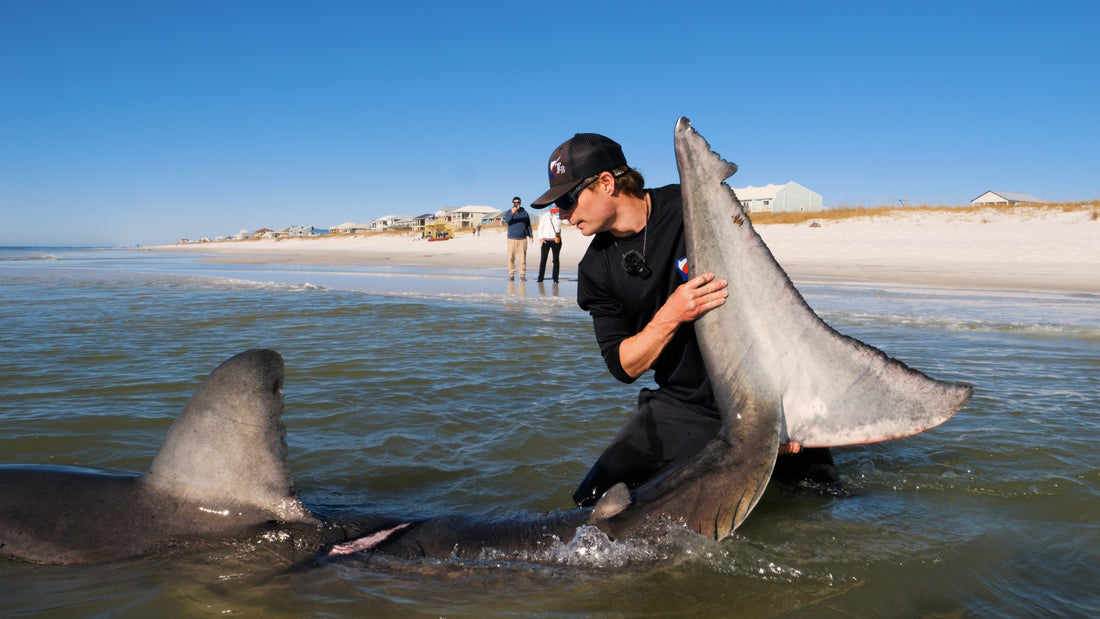
A shark's skin is abrasive enough to wear through monofilament in a few minutes of contact. Its tail wraps the leader during a fight. Its teeth are the smallest of your three problems. So a beach leader has a long mono section for stretch and clarity, a shorter cable or heavy wire section at the business end, and swivels rated far above your drag.
Our deployment leaders run 40 feet of 800 pound mono into 5 feet of 700 pound 49-strand coated cable, with 6/0 swivels and a 4/0 snap swivel. That is the Coastal Worldwide Shark Leader we sell and the one we tie on when a client's bait is going out on the kayak. For casting, the leader gets shorter so it will load a rod, which is what the Coastal Worldwide cast out leaders are built around.
Three leader rules we do not bend:
- Crimp, do not knot, anything over 200 pound test. Heavy mono knots slip under sustained load. Crimp with the right size sleeve and a real crimping tool, then check every crimp with a pull before it goes in the water.
- Swivel rating above your peak drag, with room. A swivel rated at 200 pounds on a setup you fish at 30 is not overkill once you add a wave, a wrapped tail, and a hard headshake all landing at the same instant.
- Inspect after every fish. Run the whole leader through your bare hand. Any nick, any flat spot on the cable, any swivel that grinds instead of spinning, and that leader comes off the truck rotation.
Hooks and the Florida circle hook rule
Florida law settles this one for you. Non-offset, non-stainless-steel circle hooks are required when targeting or harvesting sharks with live or dead natural bait, from shore and from a vessel. Treble hooks and other multiple hooks are prohibited for harvest with natural bait. The FWC shark regulations also require you to carry a device capable of quickly cutting the leader or hook.
Those rules are good fishing, not paperwork. A non-offset circle hook finds the corner of the jaw on its own, which means a clean release and a fish that swims off strong. Stainless is prohibited for a reason: if a hook does have to stay in a fish, you want one that corrodes out.
Sizing for land-based work runs big. We fish 16/0 to 24/0 circles depending on bait size. Match the hook to the bait, not to the shark you are hoping for. A hook buried in a bait that is too small tends to come back with the point still clean.
Sharpen out of the box. Most heavy circle hooks ship dull enough to bounce off a shark's jaw. Ten passes with a file on each side of the point, and check it again before every deployment.
Setting the hook is not a thing you do
Circle hooks set themselves against a steady load. Let the rod load up, push the drag forward, and start winding. Swinging on a circle hook pulls it straight out of the corner of the mouth. This is the single most common mistake we correct on a first trip.
Weights that hold in Gulf current
Pensacola Beach has a longshore current that will walk a plain sinker down the beach and into your neighbor's spread inside of ten minutes. A round lead does not hold. You need legs.
Spider weights dig into the sand and stay put. We run copper leg spider weights when the current is ripping and stainless leg spider weights the rest of the time. Copper legs bend and reset, so they release from a snag and can be bent back by hand. Stainless holds harder and lasts longer.
If you already own a pile of plain sinkers, the Terra Firma grip lead converters clip legs onto whatever lead you have. The legs fold flat for transport, which matters when you are carrying gear a quarter mile down a beach in the dark.
Weight range for the Gulf: 6 to 8 ounces on a calm night, 10 to 16 ounces when the wind has been onshore for a couple of days. Go heavier than you think. A bait that moves is a bait that tangles the next rod over.
Sand spikes and the rest of the beach kit
Sand is the enemy of every piece of gear you own, and a rod on the ground picks up sand in the guides, in the reel seat, and inside the spool. A real sand spike keeps the rod up and keeps the reel clear of the wash when the tide pushes in.
The HD Shark Sand Spike stands 59.5 inches, built from 1.75 inch by quarter inch 6061 structural aluminum angle, with a 12 inch upper tube and a PVC insert so the rod butt is not grinding on metal. Deerfield Fabrication builds them with us. For lighter surf rods, the Open Face 2.0 sand spike has a horseshoe top lined with EVA foam that protects the grip.
The rest of what rides in the truck on every trip:
- Bolt cutters and a knife. The leader-cutting device FWC requires. Keep them where you can reach them in the dark, not in the bottom of a bag.
- Fighting belt and harness. A 300 pound fish and a gimbal butt against your stomach for half an hour is a bad combination without one.
- Long-nose dehookers. Distance between your hands and the teeth.
- Headlamps, plus a spare set of batteries. Red light preserves your night vision and keeps the beach dark for everyone else.
- Gloves. For handling leader, not for handling sharks.
- A tape measure, only if you plan to keep a legal shark with a size minimum. We don't tape the sharks we release. The seconds matter more to the shark than the number does.
Shark fishing tackle compared: cast out vs kayak deployed
Most of the confusion around shark fishing tackle comes from mixing these two approaches. They ask for different gear. Here is how they split.
| Component | Cast out from the sand | Kayak or drone deployed |
|---|---|---|
| Rod | 9 to 12 ft, 6 to 12 oz rating | 6'6" to 8', 50 to 130 or 80 to 130 lb class |
| Reel capacity | about 300 yds of 65 to 80 lb braid | 800+ yds, lever drag |
| Leader | Short, castable, 6 to 10 ft total | 40 ft of 800 lb mono into 5 ft of cable |
| Hook | 16/0 to 20/0 non-offset circle | 20/0 to 24/0 non-offset circle |
| Weight | 6 to 10 oz spider or grip lead | 10 to 16 oz spider weight |
| Typical distance | 70 to 120 yds, past the first bar | 200 to 800 yds, second and third bar |
| Best for | Blacktip, sharpnose, bonnethead, spinner | Bull and other large coastal sharks |
New anglers should start with the cast-out setup. It is cheaper, it catches more fish per night, and it teaches you to read the beach before you add the complication of paddling a bait through the surf in the dark. Our full breakdown of the progression is in the beginner to overnight guide, and bait selection gets its own treatment in our shark bait guide.
Gear choices that change your permit requirements
Florida ties several of these tackle decisions directly to the shore-based shark permit, and plenty of anglers trip over it without knowing. Anglers 16 and older need a Florida saltwater fishing license, and shore-based shark anglers also need the free Shore-based Shark Fishing permit after completing the Shark-Smart Fishing course at MyFWC.com/SharkCourse. Both renew annually.
The part that catches people out: the permit is required if you are 16 or older and fishing from shore for any species while doing any of the following:
- Fishing with a metal leader longer than 4 feet
- Using a fighting belt or harness
- Deploying bait by any means other than casting, kayaking for example, while using a hook 1.5 inches or larger at the widest inside distance
Our 5 foot cable section clears the 4 foot metal leader threshold on its own. Add a fighting belt and a kayak deployment and you have hit all three. Anglers under 16 do not need the permit but do need the course, unless they are fishing with someone who holds one.
Worth knowing: chumming is prohibited when fishing for any species from the beach. Bag limit is one shark per person per day, Group 2 species like bull, nurse, and spinner carry a 54 inch fork length minimum, and Group 1 species like blacktip, bonnethead, and Atlantic sharpnose have no minimum size. We practice safe catch and release shark fishing for conservation, so those limits rarely come into play on our trips, but you should know them.
Prohibited species including great white, all hammerheads, tiger, lemon, dusky, sandbar, and sand tiger cannot be targeted, harvested, or removed from the water. If one eats your bait, it stays in the wash and goes back without delay. That is another argument for the heavy leader and the bolt cutters within arm's reach: a fast, clean release needs the right tackle sitting ready. The full rundown lives in our Florida shark fishing regulations guide.
Where the tail wrap shows up
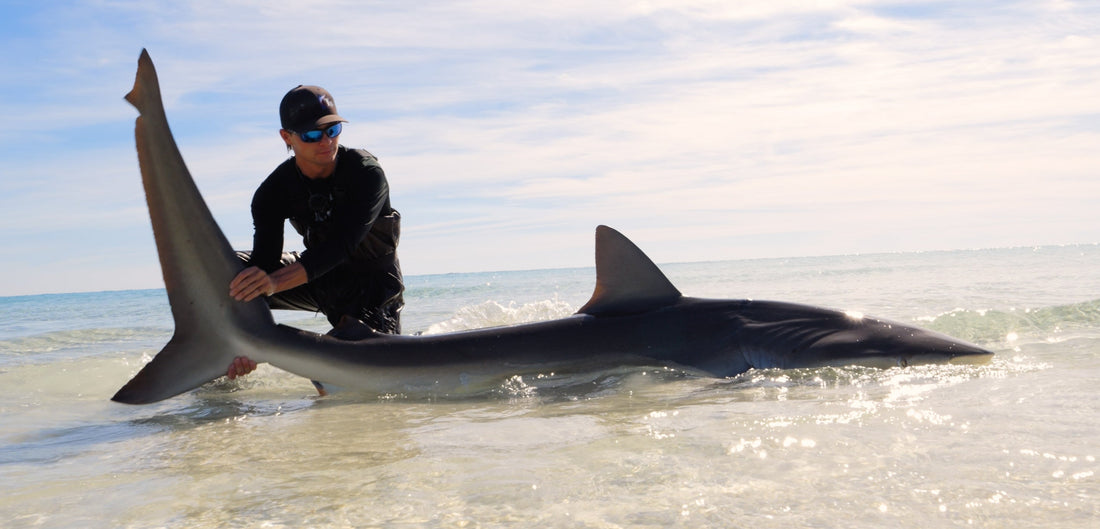
The same thing happens several times a season on our trips, and it is the best argument we have for the cable section. A big fish gets deep into a fight, turns, and wraps the leader with its tail. Nobody sees it happen. The rod goes slack, everyone assumes the fish is gone, and then it comes back tight.
Every time, the tell is on the leader afterward. A scuffed section of cable. A crimp with a witness mark on it. A stretch of mono that has gone cloudy from abrasion. That damage is a leader doing its job, and it is damage a plain mono leader would not have survived on a fish of that size.
Our rule after any decent fish is the same: run the leader through a bare hand, and if anything catches, it comes out of rotation. Leaders are consumable. The trip is not. Dylan and Blaine put a lot of this gear on camera on the Coastal Worldwide YouTube channel if you would rather see it than read about it.
Shark fishing tackle FAQ
Can I use my surf rod for sharks?
For sharpnose, bonnethead, and small blacktip, yes. A 10 foot surf rod with a 6000 to 8000 size reel and 50 pound braid handles fish up to about four feet. Beyond that you are undergunned. Undergunned tackle means you cannot push heavy drag, the fight drags out, and that is hard on the shark.
Do I need a wire leader?
You need abrasion resistance at the hook end. Coated 49-strand cable is the standard for land-based work because it resists both teeth and skin. Single strand wire kinks and fails. Straight heavy mono works on smaller sharks but will not survive a tail wrap from a big one.
Are stainless hooks allowed in Florida?
No. Non-offset, non-stainless-steel circle hooks are required when targeting or harvesting sharks with live or dead natural bait, from shore and from a vessel.
Ballpark cost for a full land-based setup?
A capable cast-out rig runs roughly 400 to 800 dollars for rod, reel, line, and terminal tackle. A deployment setup with a big lever drag reel, 800 yards of line, and heavy leaders lands closer to 1,500 to 2,500 dollars per rod. Renting the experience through a guided trip is the cheaper way to find out whether you want to own it.
Does Coastal Worldwide provide tackle on trips?
Yes. Rods and reels, our shark leaders, fresh bait, the kayak for deployment, a fighting harness, sand spikes, and beach chairs all come with the trip, and our crew handles rigging, bait prep, fish handling, and release. Anglers 16 and older will need a Florida saltwater fishing license and the shore-based shark permit. The full packing list is on our what to bring page.
If you want to see this rig built step by step instead of reading about it, the free Shark Fishing Academy at catchmoresharks.com walks through every knot, crimp, and leader we run.
Book a trip and fish the gear before you buy it
Buying a full land-based setup on a guess is an expensive way to learn what you like. Come fish ours first. We run beach shark fishing trips in Pensacola, FL with everything on this page already rigged and in the truck, and you will leave knowing which rod length feels right in your hands and whether you want a lever drag or a star.
Summer and fall book up first. Get in touch with Dylan and Blaine to check availability, or read up on bull shark fishing in Pensacola if you want to know what the heavy setup is built for.
